
Preface: How We Got Here
So, I’m commuting to work today morning, browsing BlueSky as I’m wont to do at times, when I come across this post:
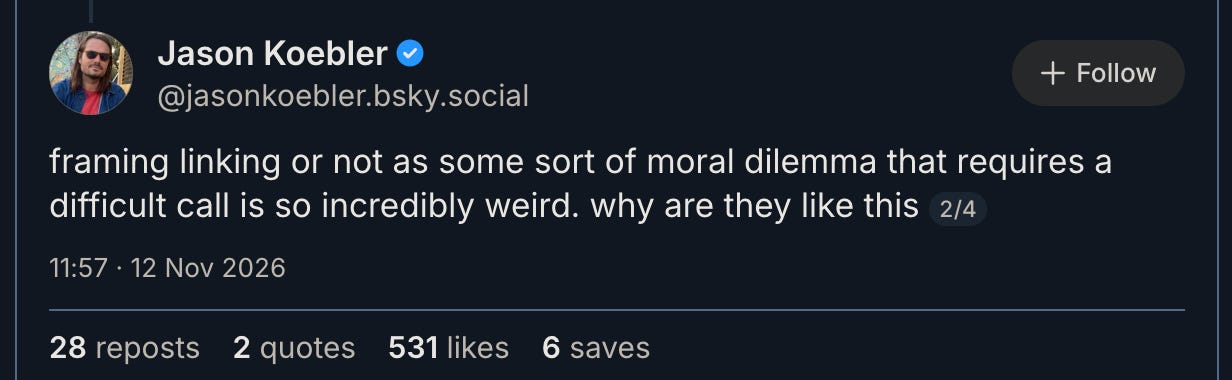
And so began the tumble down the rabbit hole.
This was a part of a thread (as indicated by the small 2/4 next to the main post text) from 404 Media’s Jason Koebler, responding to a section in the NYTimes’s “The Backstory” newsletter (archived here and here). Curious about what possible context would prompt this kind of reaction, I read the piece.
My confusion only grew.
Before we go further, a disclaimer: I’m not a journalist. If there’s some arcane J-school handbook about how and when to cite sources in that specific field, I’m not privy to it. I’m just a dude who engages with things made by others on the Internet and (very occasionally) makes things himself.
Similar Situations, Dissimilar Decisions
I’ll start at the same place that the piece itself does – the two cases that prompted all of this. First:
Our reporters found out that he was spending most of his time reading, including the Bible and the Quran. But before our article ran, there was a deeply reported piece in The New Yorker on the same subject that also mentioned his Bible reading. The New Yorker wasn’t our source; should we have acknowledged it anyway?
We decided to do it — both as a gesture of generosity and because we didn’t want to imply that we’d been the first or only reporters to discover the Bible detail.
OK, decent start. A bit weird to frame it as “a gesture of generosity” (with what, exactly, are you being generous?), but not a big deal.
Then the second case:
We wrote a 1,300-word article about Republicans who lost dozens of races across North Carolina. It included two sentences about a sheriff who had made anti-immigrant remarks and lost to a pastor who wanted to build trust with immigrants. Our reporter in Raleigh had learned about that election through interviews and social media.
Here’s the rub: A nonprofit political news site, Bolts, had done extensive reporting on that sheriff’s race months ago. After our article was published, the editor of Bolts pointed that out on social media and noted that one of our sentences about the race was similar to a line atop a Bolts article. We had seen the Bolts headline but hadn’t read the article.
I decided against adding a credit.
For context, the “I” in “I decided against…” is the credited author of this edition of the newsletter, Patrick Healy, whose description states “I’m the assistant managing editor for Standards and Trust.” OK, makes sense that’d be the person you’d want to be talking about this kind of issue.
That said… ?????????
Two articles, two cases of independent discovery of facts reported by another outlet… and two different decisions as regards credit?
OK, well, the whole point of this section is explaining (to quote the first paragraph of said section) “When do our articles recognize the work of other news organizations?”, so presumably we’re going to get into what differentiates the two? That’s a decent hook, I guess. Or, well, at minimum, you’ve hooked me!
An Explanation That Explains Nothing
The immediate next sentence ostensibly gives an explanation:
Doing so after the fact would have suggested that we had relied on Bolts but failed to acknowledge it, or that our stories were similar, neither of which was the case.
So, by implication of including “after the fact”, I guess the New Yorker credit went into its piece before it went live?
… Does that matter? Appended credits, corrections, and general updates are, to the best of my knowledge, routine newsroom practices. Heck, sometimes those exact things lead to more content. Why is the timing relevant here?
Also, as Koebler notes (in post 4/4 in that earlier-linked thread):
Linking to something does not mean “we took the information from here”
I’m not sure why the Times feels that “doing so after the fact” might suggest that they “relied on Bolts”? After all, the New Yorker wasn’t a source either, but they were credited.
Healy goes on to say
When outlets elsewhere break a story, I believe that they deserve to be named.
Why would Bolts’ months-old, extensive on-the-ground reporting of the race not qualify as “breaking this story”? Maybe there’s a specific meaning to it that I’m not grasping, but if so that should… y’know… be explained? In this explanation?
Healy later gives a perspective from NYTimes executive editor Joe Kahn on the matter of credit:
[Kahn] said his approach to giving credit was that “we should be generous rather than grudging.”
This entire “defense” reads as the exact opposite of that.
“Guiding readers to previous work can be valuable even when it’s not strictly required as a disclosure,” [Kahn] added. “It can point people to relevant reporting that might allow them to go deeper on a subject, or to understand better how coverage of an issue has evolved.”
Maybe you’ll disagree, but it seems to me like an article specifically about this sheriff’s race published in June of this year provides both “coverage of how an issue has evolved” and would allow readers “to go deeper” into this subject, considering the NYTimes’s “1,300-word article” was about races all across North Carolina, not just this one race.
That last Kahn quote is where the section ends, and thus was I left more confused than I had been when I started. If I didn’t know better, I would think those quotes are from a response criticizing the decision not to credit Bolts.
The Actual Context
Desperate at this point to have a glimmer of light shed on this unfolding drama (note: I may be exaggerating slightly), I reread the section, but to no avail. OK, maybe the newsletter is supposed to be taken in whole, and I’ll understand everything if I read to the end? No dice.
Then I scrolled back up, and saw the following line in the preface to this entire edition:
Today in The Backstory [...] we explain how we approach giving credit to the reporting of our competitors.
(emphasis mine)
Oh. I see.
Later on, the section lists a bunch of other publications whose names have appeared in the last week of articles, as a sort of “no, we give credit to people!”:
Over the last week alone, Times articles mentioned reporting by The Journal, The Boston Globe, The New Jersey Globe, Agence France-Presse, Axios, The Associated Press, The Financial Times, Politico, The Cornell Daily Sun and Reuters as well as specialized sites like Cord Cutters News, Ars Technica and The North Carolina Rabbit Hole.
That’s a list of some of the largest news agencies/publications in the world, one student-run newspaper (The Cornell Daily Sun), and one solo-operation newsletter+podcast (The North Carolina Rabbit Hole).
And, per that preface’s framing, all of them, along with nonprofit political outlet Bolts and other mentioned publications like Punchbowl News and The Wall Street Journal… are The New York Times’s competitors.
I want to contrast that quote listing a bunch of news outlets with the immediately preceding line:
[C]iting your peers for their original work is a journalistic strength.
For reference again, here’s the start of that next line:
Over the last week alone, Times articles mentioned reporting by[...]
(emphasis mine)
Mentioned. Not cited, not linked, merely “mentioned”.
Those aren’t the same thing. Maybe some of those “mentions” did link back to the original pieces; I certainly couldn’t easily tell you, since that list is presented as plain text, so it’d be up to me to go through every single thing the New York Times has put out over the past week and try to find all references to each of those publications and whether they were outgoing links or just namedrops.
Where I’m Coming From
This isn’t all about abstract concepts like “ethics” or “gratitude” or “pride”. Links have objective value. The original PageRank algorithm that undergirded the Google Search Engine (disclosure: my day job is as a Software Engineer at Google, specifically in the Core Engineering area) ranked search results specifically based on the number and quality of links to a page. Effectively, it treated links to a page as equivalent to citations on the web, attaching greater importance to links originating from sites that have significant numbers of inbound links.
That is to say, if your website has a lot of inbound links to content stored on it1, that is (or at least, was) considered evidence that it’s highly trusted/cited; as such, links outward from your site are more valuable to the target of the link, and weighted more highly, than, say, links outward from a podunk blog… and that link outward costs you absolutely nothing2.
From the perspective of a (self-proclaimed) writer, this reticence to link outward somehow makes even less sense. The biggest anxiety I have whenever I’m drafting anything is “Have I missed something that someone else already said?” I view every resource I can point to as evidence that I’m not hallucinating my harebrained ideas, and every counterargument I address as evidence that I’ve taken a hard look at the weak spots. When I’m doing my research, a piece that links outward liberally is a gift to me, because just by finding that piece, I am (and, through me, the audience is) exposed to numerous different perspectives and facts.
Even as “just” a reader/viewer, though, knowing the provenance of information can be both valuable and entertaining. Whenever this topic comes up, I’m reminded of the irony of CGP Grey’s videos on the origin and history of the name Tiffany (published 09 Aug 2021) and a 20 minute rant about Thomas Hearne (published precisely one month later). The latter was made as a supplement/appendix to the former, frequently calls back to it, and closes with the line
> I guess I just really needed to get out all of this frustration, to tell you the story of tracking down a poem that didn’t even make it into the main video. The End.
(emphasis mine)
As you may have already noticed if you clicked through those earlier links, the “main video” has slightly less than 6 million views at time of writing, whereas the “side video” has… almost 10.5 million views.
Conclusion
I’m left wondering what exactly is the cost of a link. Why must they be jealously protected and kept precious like a ring that lets the wearer turn invisible? What’s the zero-sum calculation being run, where a link to The New Yorker can be considered “a gesture of generosity” rather than the simple act of letting readers consider other viewpoints and facts that didn’t make it into your piece? What’s so wrong if people did view an after-the-fact addition as a “suggest[ion] that we had relied on Bolts but failed to acknowledge it, or that our stories were similar”?
To contrast those two cases one more time, why is it fine to imply, by omission, that your coverage of that sheriff’s race was the first or only relevant coverage, when crediting The New Yorker for an inane fact like “Maduro reads the Bible” was viewed as necessary, or at least preferable, to avoid exactly that implication?
As I see it, a link costs nothing; refusing one is the small thing.
Perhaps because you’re a journalistic juggernaut known the world over, and, possibly, the etymology for the phrase “newspaper of record”, say.
As described in the original paper, outgoing links are deduplicated (i.e. if you link www.example.com 7 times on a page, it’s treated as one outgoing link to example.com), and then the “weight” of the page is divided evenly among all those outgoing links. What if that page had no outgoing links? Then its weight is divided evenly across every single page in the search index. Having no outgoing links doesn’t somehow mean that weight is hoarded by the page to increase its own importance; it’s just spread out across the entire index.